Built to make Indian and Arabic languages sound at home on any device
Dheemanth Reddy and Ananya Krishnamurthy started Maya Research in 2024 after noticing that most TTS systems trained on English corpora produce unnatural prosody when adapted to Indic and Semitic scripts. The problem is not just accent: it is the rhythm, sandhi rules, and tonal envelope that make a spoken sentence feel native to the listener. Maya Research exists to close that gap. The company is angel-backed and based in Bengaluru.
Two researchers building the infrastructure for voice in underrepresented languages
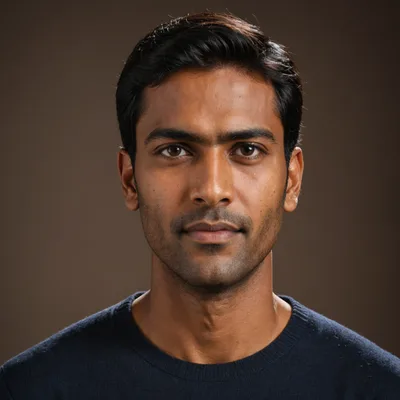
Dheemanth spent years building speech interfaces for low-bandwidth environments across rural India, where unreliable connections and non-English-speaking users made standard TTS systems fail in practice. That work sharpened his focus on prosody and naturalness at the phoneme level for morphologically-rich languages. He started Maya Research to build the system he kept wishing existed.

Ananya brings a deep background in acoustic modeling and streaming audio pipelines, with years spent on low-latency inference for edge-constrained deployments. She designed Maya Research's streaming architecture from the ground up, optimizing first-byte latency without sacrificing prosody quality. She holds the system design for every language in the current model family.
Three principles that guide every product decision
Open by default
Weights ship alongside the API. Developers can inspect, fine-tune, and deploy models independently of our hosted service. Open weights are not a marketing feature: they are a commitment to the community building on this infrastructure.
Language accuracy first
We benchmark prosody error rate, not just intelligibility. A sentence that a speaker can parse is not good enough if its rhythm marks the speaker as foreign. Naturalness is the target, and we measure it the way linguists measure it.
Built for builders
Developer ergonomics is a product feature. Clean SDK, consistent error codes, streaming by default, sensible latency contracts. If integrating Maya TTS takes more than five minutes, something is wrong on our side.
These principles were not written after the product shipped. They came from the constraints of the problem: Indic and Arabic TTS is a research-heavy domain where closed systems have consistently lagged. The only path to quality at scale is open collaboration, rigorous measurement, and tooling that developers can actually use.
We publish our benchmark methodology in the Lab. We release model weights under permissive licenses. And we build the API the way we would want to consume it.
Independently focused on long-term language research
Maya Research is angel-backed ($250K, February 2026). The funding covers compute for training runs, early engineering hires, and the infrastructure costs of running a streaming API at early-access scale. We are independently focused on long-term language research and ship open weights as a commitment to the community that no round of institutional funding can revoke. We are not optimizing for an exit. We are optimizing for the day when a developer in Chennai or Ramallah can build a voice application as easily as a developer in San Francisco.